Simulate the real exam experience with 65 questions and a 130-minute time limit. Practice with AI-verified answers and detailed explanations.
AI-Powered
GPT Pro, Claude Opus, and Gemini Pro cross-check every answer and explanation. See the reasoning for each option, requirement breakdowns, and solution architectures.
A telemedicine startup runs a web portal where 12 partner clinics upload DICOM images (up to 5 GB each) to an Amazon S3 bucket using presigned URLs, and the company must enforce encryption in transit for all uploads/downloads while ensuring that any objects containing patient identifiers are encrypted at rest with AWS KMS keys that the security team can rotate on demand; which combination of steps will meet these requirements? (Choose two.)
Keep your exam routine moving
Get timed mock exams, AI explanations, focused review, and learning insights.
Study period: 1 month
I passed with 793 and solved at least 30 questions every day. It was convenient to practice whenever I had a spare moment away from home.
Study period: 2 months
The app questions were very similar to the exam, and the explanations helped me understand why the wrong choices were incorrect.
Study period: 1 month
Thank you very much, these questions are wonderful !!!
Study period: 2 months
I passed a month ago and am only now writing a review. The question structure was similar to the exam.
Study period: 2 months
I just passed the exam, and I can confidently say that this app was instrumental in helping me thoroughly review the exam material.
Download Cloud Pass and start practicing all AWS Certified Developer - Associate (DVA-C02) exam questions.
A logistics company exposes a Regional Amazon API Gateway REST API (GET /shipments/{trackingId}) that invokes an AWS Lambda function using Lambda proxy integration; on 2024-11-03 at 14:25:33 UTC, a developer runs curl -i https://api.company.example/prod/shipments/42 and receives HTTP 502, API Gateway execution logs show 'Method completed with status: 502', and the Lambda’s CloudWatch Logs indicate the handler completed successfully and returned the plain string 'OK' (2 bytes) with no stack trace; to resolve the error and have the API return 200, what should the developer change?
A fintech team uses AWS CloudFormation to deploy an EventBridge-triggered AWS Lambda function whose code is a zipped artifact stored in Amazon S3 (bucket artifacts-567890-us-east-1 with versioning enabled, key builds/processor.zip, last version ID 3Lg8xZ2), but every time they run a stack update while keeping the same S3 object key, the Lambda function code does not change; what should they do to ensure CloudFormation applies the new code during updates?
A fintech startup operates 340 AWS Lambda functions in us-west-2 that must be tested via Lambda function URLs, and the internal verification team grouped in an IAM group named QA-Reviewers needs to invoke all endpoints using the public URLs while blocking anonymous access, so as the developer, how should you configure authentication and permissions at scale to meet these requirements?
A media analytics startup needs to publish a public REST API with 7 endpoints in Amazon API Gateway within 2 weeks so partner teams can integrate now, even though its backend microservices will not be ready until the next sprint, and the company requires returning static JSON payloads (<=2 KB) that produce HTTP 200 or 404 based on request parameters, with no backend integration and no compute/VPC costs—what solution should the developers implement?
A mobile gaming company is deploying a leaderboard service and will create an Amazon DynamoDB table using an AWS CloudFormation template; compliance requires server-side encryption at rest with an AWS owned key to avoid any KMS key administration, and the table must launch in us-east-1 with 100 write capacity units and 250 read capacity units. How should the engineer define the table to meet these requirements?
A fintech startup is refactoring its fraud scoring microservice from Amazon ECS on Amazon EC2 to a serverless design; the service uses an Amazon Aurora PostgreSQL-Compatible Edition cluster deployed in two private subnets (10.0.2.0/24 and 10.0.3.0/24) within a single VPC (10.0.0.0/16) with no internet gateway routes from those subnets, and the company needs new AWS Lambda functions to connect to the cluster over TCP port 5432 while keeping all resources private and granting only the minimum network access; which solution will meet these requirements?
A team is building a serverless image-watermarking microservice that is triggered by Amazon S3 ObjectCreated events from two buckets (raw-photos and raw-logos) and routes failures to an Amazon SQS dead-letter queue. The team must use standardized infrastructure templates and be able to run and debug the function and event flow locally with Docker before deployment. The organization already has a single AWS CodePipeline pipeline per environment (dev, test, prod) and wants any infrastructure changes for this microservice to be deployed through the existing pipeline stages. Which solution will meet these requirements?
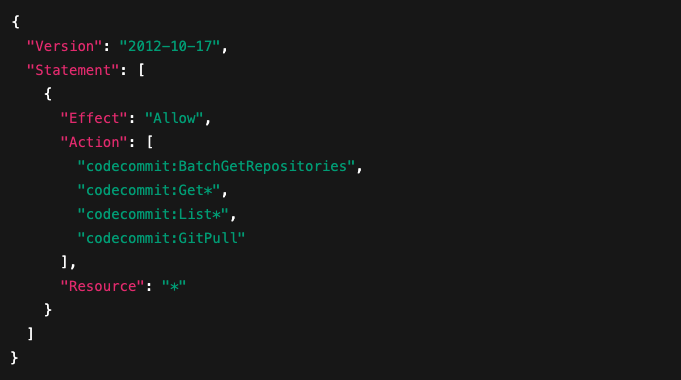
A CI server authenticates to AWS CodeCommit over HTTPS using an IAM user whose current policy (see the provided policy JSON) allows only read operations—BatchGetRepositories, Get*, List*, and GitPull—yet the pipeline must create and delete temporary release/* branches on each build while following the principle of least privilege; which specific IAM permissions should be added?

A startup is building an order-fulfillment microservice with AWS CDK (TypeScript) that defines 3 AWS Lambda functions and one Amazon API Gateway REST API, and the developer who has both AWS CDK and AWS SAM installed locally needs to run only the PaymentProcessorFunction (Node.js 18.x) on their laptop without deploying to AWS by using the CloudFormation template produced during synthesis located at cdk.out/OrdersStack.template.json; what is the correct way to test this single function locally?