


Practice Test #4
Simulate the real exam experience with 50 questions and a 100-minute time limit. Practice with AI-verified answers and detailed explanations.
AI-Powered
Triple AI-Verified Answers & Explanations
GPT Pro, Claude Opus, and Gemini Pro cross-check every answer and explanation. See the reasoning for each option, requirement breakdowns, and solution architectures.
Practice Questions
Note: This question is part of a series of questions that present the same scenario. Each question in the series contains a unique solution that might meet the stated goals. Some question sets might have more than one correct solution, while others might not have a correct solution. After you answer a question in this section, you will NOT be able to return to it. As a result, these questions will not appear in the review screen. You are developing an Azure solution to collect point-of-sale (POS) device data from 2,000 stores located throughout the world. A single device can produce 2 megabytes (MB) of data every 24 hours. Each store location has one to five devices that send data. You must store the device data in Azure Blob storage. Device data must be correlated based on a device identifier. Additional stores are expected to open in the future. You need to implement a solution to receive the device data. Solution: Provision an Azure Event Grid. Configure event filtering to evaluate the device identifier. Does the solution meet the goal?
You develop Azure solutions. You must connect to a No-SQL globally-distributed database by using the .NET API. You need to create an object to configure and execute requests in the database. Which code segment should you use?
DRAG DROP - You develop a web app that uses the tier D1 app service plan by using the Web Apps feature of Microsoft Azure App Service. Spikes in traffic have caused increases in page load times. You need to ensure that the web app automatically scales when CPU load is about 85 percent and minimize costs. Which four actions should you perform in sequence? To answer, move the appropriate actions from the list of actions to the answer area and arrange them in the correct order. NOTE: More than one order of answer choices is correct. You will receive credit for any of the correct orders you select. Select and Place:
Exhibit:
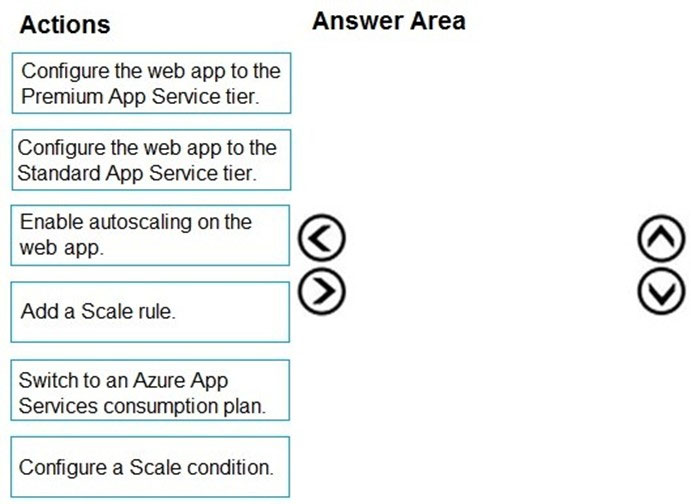
Which sequence minimizes cost while enabling autoscale when CPU load is about 85 percent?
DRAG DROP - You develop a web application. You need to register the application with an active Azure Active Directory (Azure AD) tenant. Which three actions should you perform in sequence? To answer, move all actions from the list of actions to the answer area and arrange them in the correct order. Select and Place:
Exhibit:
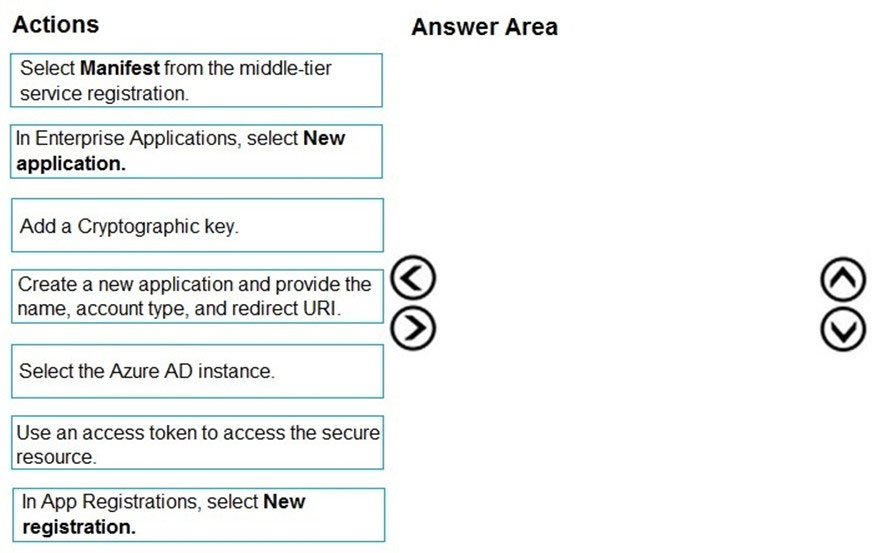
Which sequence registers the web application with the active Azure AD tenant?
HOTSPOT - You are developing an Azure Web App. You configure TLS mutual authentication for the web app. You need to validate the client certificate in the web app. To answer, select the appropriate options in the answer area. NOTE: Each correct selection is worth one point. Hot Area:
Client certificate location: ______
Encoding type: ______
Keep your exam routine moving
Get timed mock exams, AI explanations, focused review, and learning insights.
Note: This question is part of a series of questions that present the same scenario. Each question in the series contains a unique solution that might meet the stated goals. Some question sets might have more than one correct solution, while others might not have a correct solution. After you answer a question in this section, you will NOT be able to return to it. As a result, these questions will not appear in the review screen. You are developing an Azure Service application that processes queue data when it receives a message from a mobile application. Messages may not be sent to the service consistently. You have the following requirements: ✑ Queue size must not grow larger than 80 gigabytes (GB). ✑ Use first-in-first-out (FIFO) ordering of messages. ✑ Minimize Azure costs. You need to implement the messaging solution. Solution: Use the .Net API to add a message to an Azure Service Bus Queue from the mobile application. Create an Azure Function App that uses an Azure Service Bus Queue trigger. Does the solution meet the goal?
You develop an app that allows users to upload photos and videos to Azure storage. The app uses a storage REST API call to upload the media to a blob storage account named Account1. You have blob storage containers named Container1 and Container2. Uploading of videos occurs on an irregular basis. You need to copy specific blobs from Container1 to Container2 when a new video is uploaded. What should you do?
Note: This question is part of a series of questions that present the same scenario. Each question in the series contains a unique solution that might meet the stated goals. Some question sets might have more than one correct solution, while others might not have a correct solution. After you answer a question in this section, you will NOT be able to return to it. As a result, these questions will not appear in the review screen. You develop an HTTP triggered Azure Function app to process Azure Storage blob data. The app is triggered using an output binding on the blob. The app continues to time out after four minutes. The app must process the blob data. You need to ensure the app does not time out and processes the blob data. Solution: Configure the app to use an App Service hosting plan and enable the Always On setting. Does the solution meet the goal?
Note: This question is part of a series of questions that present the same scenario. Each question in the series contains a unique solution that might meet the stated goals. Some question sets might have more than one correct solution, while others might not have a correct solution. After you answer a question in this section, you will NOT be able to return to it. As a result, these questions will not appear in the review screen. You are developing a website that will run as an Azure Web App. Users will authenticate by using their Azure Active Directory (Azure AD) credentials. You plan to assign users one of the following permission levels for the website: admin, normal, and reader. A user's Azure AD group membership must be used to determine the permission level. You need to configure authorization. Solution: ✑ Create a new Azure AD application. In the application's manifest, define application roles that match the required permission levels for the application. ✑ Assign the appropriate Azure AD group to each role. In the website, use the value of the roles claim from the JWT for the user to determine permissions. Does the solution meet the goal?
Note: This question is part of a series of questions that present the same scenario. Each question in the series contains a unique solution that might meet the stated goals. Some question sets might have more than one correct solution, while others might not have a correct solution. After you answer a question in this section, you will NOT be able to return to it. As a result, these questions will not appear in the review screen. You are developing a website that will run as an Azure Web App. Users will authenticate by using their Azure Active Directory (Azure AD) credentials. You plan to assign users one of the following permission levels for the website: admin, normal, and reader. A user's Azure AD group membership must be used to determine the permission level. You need to configure authorization. Solution: ✑ Create a new Azure AD application. In the application's manifest, set value of the groupMembershipClaims option to All. ✑ In the website, use the value of the groups claim from the JWT for the user to determine permissions. Does the solution meet the goal?

Start Practicing Now
Download Cloud Pass and start practicing all Microsoft AZ-204 exam questions.

