

Practice Test #1
50개 문제와 120분 시간 제한으로 실제 시험을 시뮬레이션하세요. AI 검증 답안과 상세 해설로 학습하세요.
AI 기반
3중 AI 검증 답안 및 해설
GPT Pro, Claude Opus, Gemini Pro가 답안과 해설을 교차 검증합니다. 선택지별 근거부터 요구사항 분해와 정답 아키텍처까지 확인하세요.
실전형 문제
A regional logistics company on Google Cloud needs to process live telemetry from delivery vans (8,000–12,000 events/second with sub-5-second aggregation windows) while also running hourly batch reconciliations of daily manifests; they have no existing analytics codebase and want a fully managed service that supports both batch and streaming with minimal operations overhead. Which technology should they use?
Your fintech company runs a payment authorization microservice as a Kubernetes Deployment with 12 replicas in a regional GKE Autopilot cluster in us-central1. During rolling updates (maxUnavailable=0, maxSurge=2), production-only configuration mistakes have intermittently caused 5xx errors at ~1,500 RPS because new Pods begin receiving traffic before the bad settings cause runtime failures. You need a platform-level preventive control so that only healthy Pods receive traffic during the rollout and faulty versions do not trigger outages. What should you do?
You operate a healthcare data processing environment on Google Cloud. All Compute Engine VMs run in VPC 'med-analytics-vpc' on subnet 'proc-subnet' (10.24.0.0/20), and an organization policy prohibits any VM from having an external (public) IP. A firewall rule denies ingress tcp:22 from 0.0.0.0/0, and there is no Cloud VPN or Cloud Interconnect to your office network (198.51.100.0/24). You must initiate an SSH session to a specific VM named 'etl-node-03' in us-central1-a for an urgent diagnosis, without assigning any public IPs or opening new inbound internet access. What should you do?
Your media analytics team runs a custom regression test harness that executes Linux-native binaries and shell scripts to validate a new codec pipeline; the full suite currently takes about 6 hours on 4 on-premises servers (24 vCPUs total) and must be reduced to under 45 minutes by parallelizing runs without rewriting the tests, with each test job needing a standard Linux VM, a custom startup script, and access to a 50-GB artifact set in Cloud Storage, and the lab triggers 10–20 full runs per workday with peak concurrency of up to 800 short-lived workers during business hours while preferring pay-as-you-go and minimal operational overhead. Which Google Cloud infrastructure should you recommend?
Your media company is building a new production environment on Google Cloud in a single VPC named media-prod with a subnet in us-central1 and will connect it to your data center using HA Cloud VPN with Cloud Router (dynamic routing); your on-premises RFC1918 address space is 10.20.0.0/16 and 172.18.0.0/16, and during a 6-month coexistence period every on-prem host must be reachable from Google Cloud and every Google Cloud workload must be reachable from on-prem without using NAT; you will also deploy a GKE cluster using alias IPs that requires two secondary ranges for Pods and Services; how should you plan the Google Cloud IP ranges to avoid reachability problems over the VPN during the migration?
합격 루틴을 앱에서 이어가세요
실전 모의고사, AI 해설, 약점 회독과 학습 분석을 모두 제공합니다.
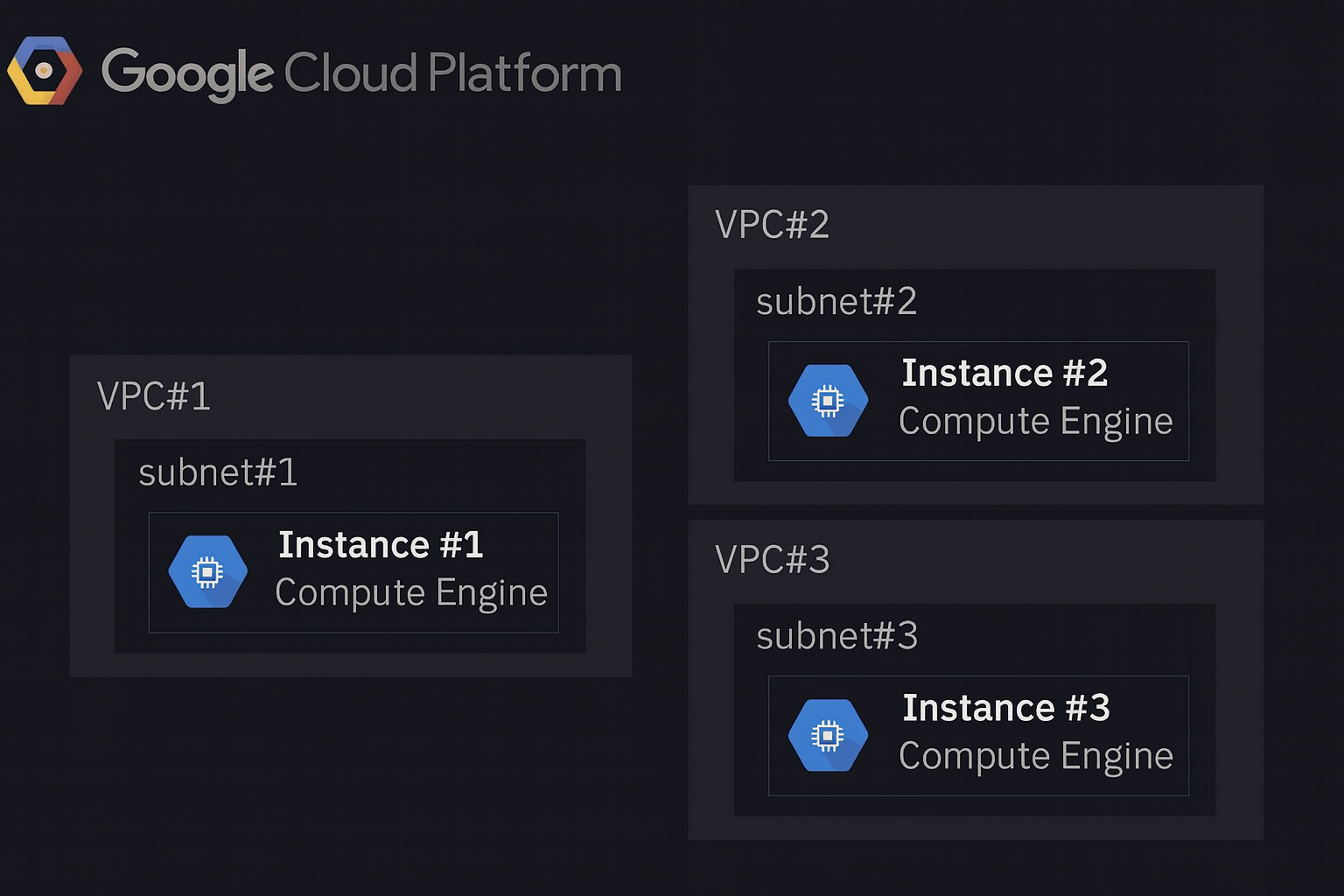
Refer to the dark-mode network diagram shown below: your company has three separate VPCs in Google Cloud, each containing one Compute Engine instance. Subnets do not overlap and must remain isolated. Instance #1 is a special case and must communicate directly with Instance #2 and Instance #3 using internal IP addresses. What should you do?
You are deploying a Cloud Run microservice that persists customer profiles in Cloud Datastore; at startup, the service must preload 50 top-level Profile entities whose numeric IDs are provided by a configuration file, and all entities are root entities with no ancestors; you want to minimize Cloud Datastore operational overhead (number of RPCs and index usage) and reduce retrieval latency; what should you do?
You operate a latency-sensitive order-matching microservice on Google Kubernetes Engine in us-central1 with a Deployment named matcher-deploy (4 replicas with readinessProbes) exposed internally via a ClusterIP Service named matcher-svc behind an Internal HTTP(S) Load Balancer; you must roll out a new container image gcr.io/acme/matcher:v2 with minimal disruption (no more than 1 pod unavailable at any time) and without recreating the Service or changing the node pool; what should you do?
You are designing an ingestion layer for a cross-continent payment event stream that feeds a reconciliation microservice requiring strict per-merchant FIFO ordering and exactly-once delivery; traffic arrives from 7 regions, spikes to 80,000 events per second, and must be processed end-to-end within 1.5 seconds while using only managed GCP services and avoiding custom brokers. Which products should you deploy to ensure guaranteed-once FIFO delivery and meet the scalability and latency requirements?
A nonprofit Earth-observation collective distributes high-resolution satellite imagery bundles for public download (each file 500 MB–3 GB, ~9 TB total), and their audience spans more than 45 countries across 6 continents; they need to minimize download latency for all users and adhere to Google-recommended practices while keeping operations simple. How should they store the files?
합격 후기(10)
학습 기간: 1 month
Many of the scenario patterns I saw on Cloud Pass showed up in the actual PCA exam. The explanations were detailed, which helped strengthen my weak areas. I’ll definitely use this app again for other GCP exams.
학습 기간: 1 month
실제 시험 문제하고 유사했던게 15개 이상 나온거 같아요! 굿굿
학습 기간: 1 month
앱 너무 좋네요
학습 기간: 2 weeks
These questions forced me to deeply understand GCP networking, IAM, storage trade-offs, and high-availability design. After a month of consistent practice, I finally passed my PCA exam. Amazing app!
학습 기간: 1 month
I passed on the first try. The practice questions were tough but very close to the real exam. The explanations helped me understand why each answer was correct. Highly recommended.

지금 학습 시작하기
Cloud Pass를 다운로드하고 Google Professional Cloud Architect 자격증 학습을 이어가세요.

