75問と180分の制限時間で実際の試験をシミュレーションしましょう。AI検証済み解答と詳細な解説で学習できます。
AI搭載
すべての解答は3つの主要AIモデルで交差検証され、最高の精度を保証します。選択肢ごとの詳細な解説と深い問題分析を提供します。
A fitness education platform runs its web tier on Amazon EC2 behind an Application Load Balancer with an Auto Scaling group and stores all static assets on Amazon EFS (General Purpose), but after launching a 1080p training video library (average file size 200 MB) traffic spiked 12x to about 20,000 concurrent users at peak and users now see 5–10 second buffering and occasional HTTP 504 errors, so which is the most cost-efficient and scalable deployment change to resolve these issues without replatforming the compute layer?
外出先でもすべての問題を解きたいですか?
Cloud Passをダウンロード — 模擬試験、学習進捗の追跡などを提供します。
学習期間: 3 months
I used these practice questions and successfully passed my exam. Thanks for providing such well-organized question sets and clear explanations. Many of the questions felt very close to the real exam.
学習期間: 3 months
Just got certified last week! It was a tough exam, but I’m really thankful to cloud pass. the app questions helped me a lot in preparing for it.
学習期間: 1 month
I made good use of the app.
学習期間: 2 months
These practice exams are help for me to pass the certification. A lot of questions are mimicked from here.
学習期間: 1 month
Thanks. I think I passed because of high quality contents here. I am thinking to take next aws exam here.
A fintech startup operates a currency-quotation API on AWS for a compliance program that will last the next 3 years. The API runs on 20 Amazon EC2 On-Demand Instances registered in a target group behind a Network Load Balancer (NLB) across two Availability Zones. The service is stateless and runs 24x7. Users report slow responses; metrics show average CPU at 10% during normal traffic, but CPU spikes to 100% during market open hours for a few hours each day. The company needs a new architecture that resolves latency during spikes while minimizing cost over the 3-year period. Which solution is the MOST cost-effective?
An independent cybersecurity auditing firm that operates under an AWS Organizations organization named blueOrg (orgA) must programmatically access a customer’s AWS account that belongs to a separate organization named greenOrg (orgB) to run an automated compliance scanner from the firm’s management account every 4 hours that reads only EC2 Describe*, IAM Get*, and S3 List* metadata using temporary credentials and least privilege. What is the MOST secure way to enable orgA to access resources in orgB via API/CLI?
A digital publishing company operates a stateful licensing API on three Windows-based Amazon EC2 instances across two Availability Zones behind an Application Load Balancer (ALB) with an Amazon RDS for PostgreSQL database in us-east-1, and the application's public DNS is hosted by a third-party DNS provider. A solutions architect must recommend a cross-Region resiliency strategy that minimizes changes to the current architecture and ensures optimal latency for users after a Regional failover to eu-west-1. The solution must meet the following objectives: • Application tier: RPO of 2 minutes, RTO of 30 minutes • Database tier: RPO of 5 minutes, RTO of 30 minutes Which solution will meet these requirements?
A media analytics startup needs to migrate its third-party thumbnail rendering engine to AWS; the vendor provides a supported Docker image from a public registry that can run in any number of containers, the company has 12 content categories (Kids, Sports, News, etc.) and wants each category to run its own isolated set of containers with a small custom configuration (category-specific environment variables and S3 prefix filters) so that each container processes only that category, peak load requires up to 50 simultaneous containers per category with jobs that last 3–5 minutes and do not need persistent storage, finance requires per-category cost allocation using tags on the running units, and the operations team needs the ability to scale resources cost-effectively purely based on the number of running containers with the least possible operational overhead; which solution meets these requirements?
A regional energy utility must archive 180 TB of monthly meter reports (PDF/CSV) for 7 years and make them available only to internal staff through the corporate intranet; employees connect via an AWS Client VPN to a VPC, all access must stay private (no public endpoints), the files are duplicate copies of records also stored on offline tape, the expected request rate is fewer than 10 retrieval batches per week, and retrieval latency of up to 12 hours is acceptable with no availability or speed-of-retrieval requirements. Which solution will meet these requirements at the lowest cost?
A media conglomerate operates 12 AWS accounts across three OUs in a single AWS Organizations organization and provisions all infrastructure exclusively with AWS CloudFormation. The compliance office must implement a chargeback model and has mandated that every new resource be tagged with the key cost-center using only one of the allowed values CC-101, CC-202, CC-303, or CC-404; however, when filtering the AWS Cost and Usage Report in AWS Cost Explorer by cost-center, the team found many missing or noncompliant values in stacks created over the past 30 days. With the least operational effort, how should the company enforce both the presence of the cost-center tag on new CloudFormation-created resources and restrict the tag’s value to the approved set across all OUs?
A digital ticketing company is modernizing its checkout application that currently runs a monolithic, load-balanced Amazon EC2 fleet serving the static web frontend, checkout/database APIs, and payment orchestration logic; the company wants a fully decoupled, serverless-first architecture that can process an average of 10,000 checkouts per hour with bursts up to 30,000 within 10 minutes, retain any failed checkout events for at least 7 days for later replay, independently scale each component, and minimize operational costs by eliminating server management. Which solution will meet these requirements?
A healthcare analytics firm must call a third-party patient-eligibility SaaS that exposes multiple REST APIs (average 600 requests per minute) and runs on AWS inside its own VPC from ECS services deployed in three private subnets across 3 Availability Zones in the firm’s VPC, where traffic must not traverse the internet (no NAT gateways or internet gateways), no resources in the firm’s VPC may be reachable from outside the firm’s VPC, all access must follow least-privilege principles, and the SaaS provider publishes an AWS endpoint service name for customers; which solution meets these requirements?
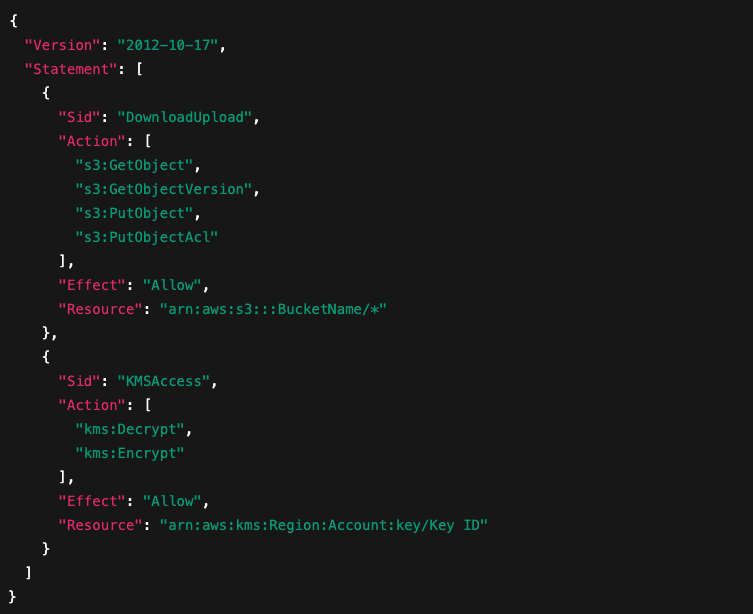
A healthcare company is building a secure document storage system for patient records. The company uses a newly created Amazon S3 bucket to store files. For compliance, the company requires client-side encryption using a customer managed CMK in AWS Key Management Service (AWS KMS). The security team attached the following IAM policy to the application role. During testing, the application was able to download and read existing files from the S3 bucket. However, when the application attempted to upload a new file, the request failed with an access denied error. Which additional action must the security team include in the IAM policy to allow encrypted uploads while maintaining compliance requirements?