


Practice Test #7
Simulate the real exam experience with 50 questions and a 100-minute time limit. Practice with AI-verified answers and detailed explanations.
AI-Powered
Triple AI-Verified Answers & Explanations
GPT Pro, Claude Opus, and Gemini Pro cross-check every answer and explanation. See the reasoning for each option, requirement breakdowns, and solution architectures.
Practice Questions
Note: This question is part of a series of questions that present the same scenario. Each question in the series contains a unique solution that might meet the stated goals. Some question sets might have more than one correct solution, while others might not have a correct solution. After you answer a question in this section, you will NOT be able to return to it. As a result, these questions will not appear in the review screen. You have an Azure subscription that contains 10 virtual networks. The virtual networks are hosted in separate resource groups. Another administrator plans to create several network security groups (NSGs) in the subscription. You need to ensure that when an NSG is created, it automatically blocks TCP port 8080 between the virtual networks. Solution: You assign a built-in policy definition to the subscription. Does this meet the goal?
You have an Azure Active Directory (Azure AD) tenant named contoso.onmicrosoft.com that contains 100 user accounts. You purchase 10 Azure AD Premium P2 licenses for the tenant. You need to ensure that 10 users can use all the Azure AD Premium features. What should you do?
You have an Azure subscription named Subscription1 and an on-premises deployment of Microsoft System Center Service Manager. Subscription1 contains a virtual machine named VM1. You need to ensure that an alert is set in Service Manager when the amount of available memory on VM1 is below 10 percent. What should you do first?
HOTSPOT - You have an Azure subscription that contains the resources shown in the following table.
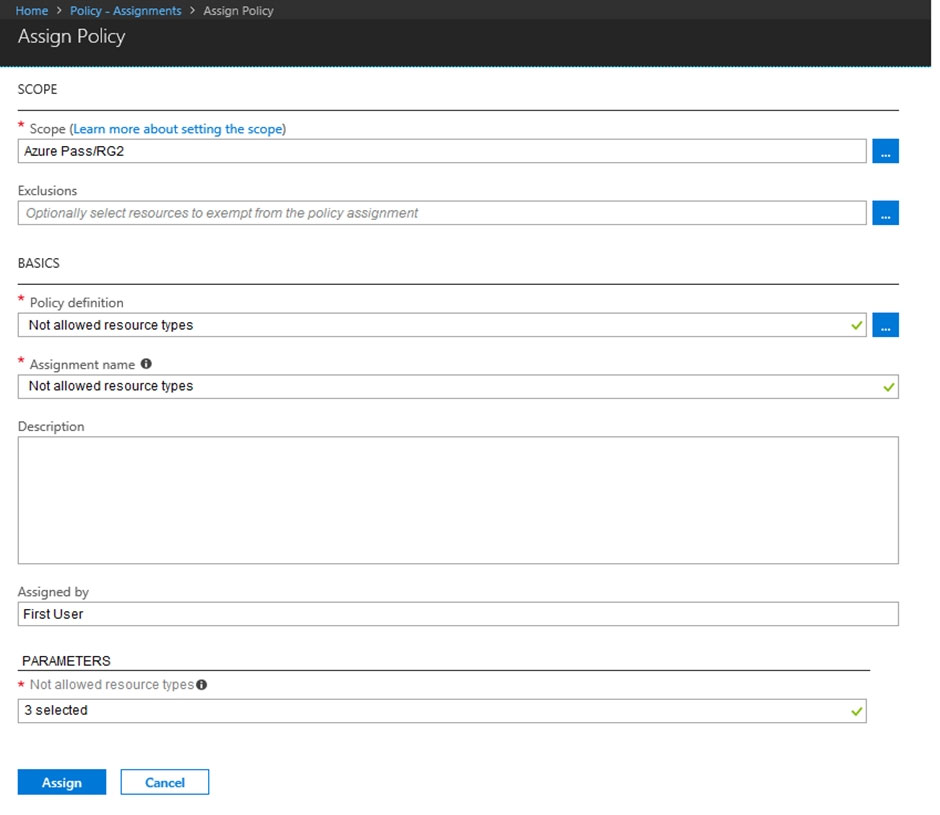
The status of VM1 is Running. You assign an Azure policy as shown in the exhibit. (Click the Exhibit tab.)
You assign the policy by using the following parameters: Microsoft.ClassicNetwork/virtualNetworks Microsoft.Network/virtualNetworks Microsoft.Compute/virtualMachines For each of the following statements, select Yes if the statement is true. Otherwise, select No. NOTE: Each correct selection is worth one point. Hot Area:
Exhibit:
VNET1 is a Virtual network in RG1.
VNET2 is a Virtual network in RG2.
VM1 is a Virtual machine in RG2.
An administrator can move VNET1 to RG2
The state of VM1 changed to deallocated
An administrator can modify the address space of VNET2
You have an Azure subscription that contains an Azure Storage account. You plan to create an Azure container instance named container1 that will use a Docker image named Image1. Image1 contains a Microsoft SQL Server instance that requires persistent storage. You need to configure a storage service for Container1. What should you use?
Keep your exam routine moving
Get timed mock exams, AI explanations, focused review, and learning insights.
Note: This question is part of a series of questions that present the same scenario. Each question in the series contains a unique solution that might meet the stated goals. Some question sets might have more than one correct solution, while others might not have a correct solution. After you answer a question in this section, you will NOT be able to return to it. As a result, these questions will not appear in the review screen. You need to ensure that an Azure Active Directory (Azure AD) user named Admin1 is assigned the required role to enable Traffic Analytics for an Azure subscription. Solution: You assign the Network Contributor role at the subscription level to Admin1. Does this meet the goal?
Note: This question is part of a series of questions that present the same scenario. Each question in the series contains a unique solution that might meet the stated goals. Some question sets might have more than one correct solution, while others might not have a correct solution. After you answer a question in this section, you will NOT be able to return to it. As a result, these questions will not appear in the review screen. You have an Azure subscription named Subscription1. Subscription1 contains a resource group named RG1. RG1 contains resources that were deployed by using templates. You need to view the date and time when the resources were created in RG1. Solution: From the RG1 blade, you click Automation script. Does this meet the goal?
HOTSPOT - You need to create an Azure Storage account that meets the following requirements: ✑ Minimizes costs ✑ Supports hot, cool, and archive blob tiers ✑ Provides fault tolerance if a disaster affects the Azure region where the account resides How should you complete the command? To answer, select the appropriate options in the answer area. NOTE: Each correct selection is worth one point. Hot Area:
az storage account create -g RG1 -n storageaccount1 --kind ______
--sku ______
DRAG DROP - You onboard 10 Azure virtual machines to Azure Automation State Configuration. You need to use Azure Automation State Configuration to manage the ongoing consistency of the virtual machine configurations. Which three actions should you perform in sequence? To answer, move the appropriate actions from the list of actions to the answer area and arrange them in the correct order. NOTE: More than one order of answer choices is correct. You will receive credit for any of the correct orders you select. Select and Place:
Choose the correct Azure Automation State Configuration sequence.
HOTSPOT - You have Azure virtual machines that run Windows Server 2019 and are configured as shown in the following table.

You create a private Azure DNS zone named adatum.com. You configure the adatum.com zone to allow auto registration from VNET1. Which A records will be added to the adatum.com zone for each virtual machine? To answer, select the appropriate options in the answer area. NOTE: Each correct selection is worth one point. Hot Area:
A records for VM1: ______
A records for VM2: ______
Other Practice Tests
Practice Test #1
Practice Test #2
Practice Test #3
Practice Test #4
Practice Test #5
Practice Test #6
Practice Test #8
Practice Test #9

Start Practicing Now
Download Cloud Pass and start practicing all Microsoft AZ-104 exam questions.

