
CloudPass LogoCloud Pass
AWSGoogle CloudMicrosoftCiscoCompTIADatabricks
Certifications
AWSGoogle CloudMicrosoftCiscoCompTIADatabricks
PL-300: Microsoft Power BI Data Analyst

Practice Test #5

50개 문제와 100분 시간 제한으로 실제 시험을 시뮬레이션하세요. AI 검증 답안과 상세 해설로 학습하세요.

50문제100분700/1000합격 점수
기출 문제 보기

AI 기반

3중 AI 검증 답안 및 해설

모든 답안은 3개의 최고 AI 모델로 교차 검증하여 최고의 정확도를 보장합니다. 선택지별 상세 해설과 심층 문제 분석을 제공합니다.

GPT Pro
Claude Opus
Gemini Pro
선택지별 상세 해설
심층 문제 분석
3개 모델 합의 정확도

기출 문제

1
문제 1

You have a Microsoft Power BI report. The size of PBIX file is 550 MB. The report is accessed by using an App workspace in shared capacity of powerbi.com. The report uses an imported dataset that contains one fact table. The fact table contains 12 million rows. The dataset is scheduled to refresh twice a day at 08:00 and 17:00. The report is a single page that contains 15 AppSource visuals and 10 default visuals. Users say that the report is slow to load the visuals when they access and interact with the report. You need to recommend a solution to improve the performance of the report. What should you recommend?

2
문제 2

HOTSPOT - You have a Power BI report. You have the following tables. Name Description Balances The table contains daily records of closing balances for every active bank account. The closing balances appear for every day the account is live, including the last day. Date The table contains a record per day for the calendar years of 2000 to 2025. There is a hierarchy for financial year, quarter, month, and day. You have the following DAX measure. Accounts := CALCULATE ( DISTINCTCOUNT (Balances[AccountID]), LASTDATE ('Date'[Date]) For each of the following statements, select Yes if the statement is true. Otherwise, select No. NOTE: Each correct selection is worth one point. Hot Area:

파트 1:

A table visual that displays the date hierarchy at the year level and the [Accounts] measure will show the total number of accounts that were live throughout the year.

At the year level, the filter context includes all dates in that year. LASTDATE('Date'[Date]) returns only the final date of that year (e.g., 31-Dec for calendar year, or the last day of the financial year if the hierarchy uses financial year boundaries). CALCULATE then evaluates DISTINCTCOUNT(Balances[AccountID]) only for that single last date. So the visual will show the number of accounts that were live on the last day of the year, not the number of accounts that were live throughout the year. “Live throughout the year” would require accounts to have Balances rows for every day in the year (or to meet a start/end date condition spanning the whole year), which this measure does not test. Therefore, the statement is false.

파트 2:

A table visual that displays the date hierarchy at the month level and the [Accounts] measure will show the total number of accounts that were live throughout the month.

At the month level, the filter context includes all days in the selected month. LASTDATE returns the last day of that month in the current context. The measure then counts distinct accounts present in Balances on that last day only. That result is not “the total number of accounts that were live throughout the month.” It is “accounts live on the last day of the month.” Accounts that were active earlier in the month but closed before month-end will be excluded, and accounts opened mid-month but still active at month-end will be included (even though they were not live for the full month). To compute “throughout the month,” you’d need logic ensuring the account appears on every day of the month (or spans the full month). Hence, No.

파트 3:

A table visual that displays the date hierarchy at the day level and the [Accounts] measure will show the total number of accounts that were live that day.

At the day level, the filter context is already a single date (each row in the table visual corresponds to one day). In that context, LASTDATE('Date'[Date]) returns that same date. Therefore, CALCULATE applies a filter that effectively keeps the same single day. Because Balances contains a daily record for every account that is live on that day, DISTINCTCOUNT(Balances[AccountID]) for that date returns the number of accounts live that day. This matches the statement exactly. Therefore, Yes.

3
문제 3
(2개 선택)

You have a Microsoft Excel file in a Microsoft OneDrive folder. The file must be imported to a Power BI dataset. You need to ensure that the dataset can be refreshed in powerbi.com. Which two connectors can you use to connect to the file? Each correct answer presents a complete solution. NOTE: Each correct selection is worth one point.

4
문제 4

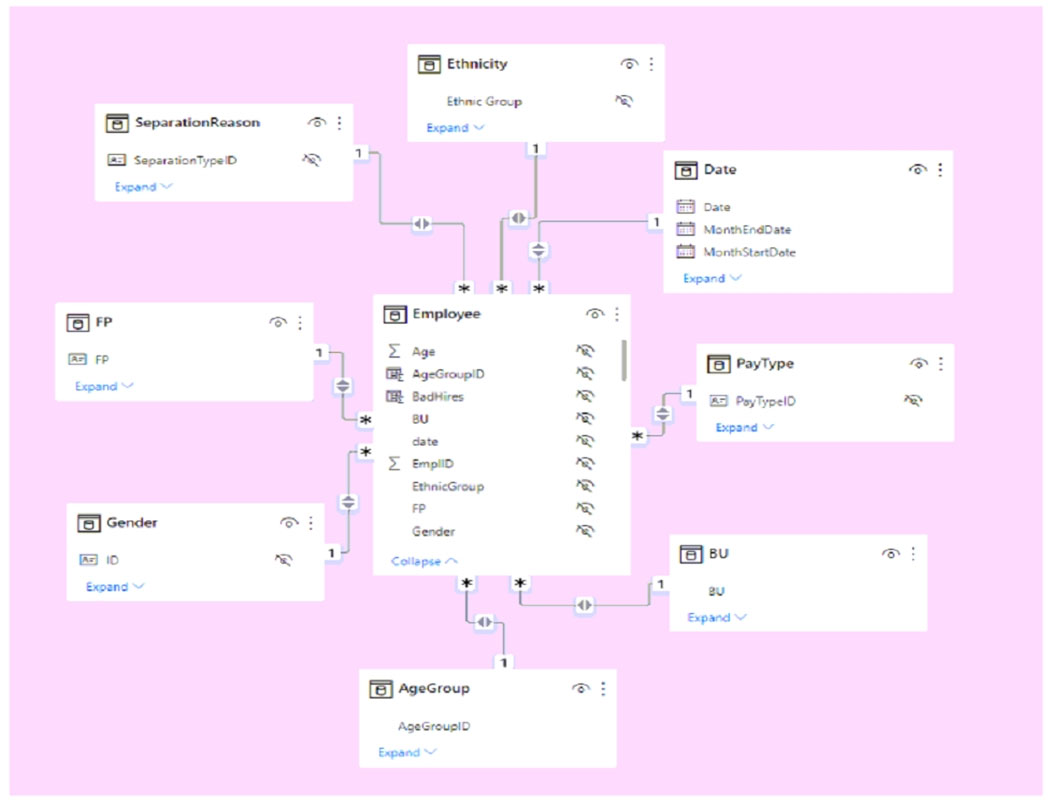
HOTSPOT - You have a Power BI imported dataset that contains the data model shown in the following exhibit.
diagram

Use the drop-down menus to select the answer choice that completes each statement based on the information presented in the graphic. NOTE: Each correct selection is worth one point. Hot Area:

파트 1:

Changing the ______ setting of the relationships will improve report query performance.

Correct answer: B (Cross filter direction). In an imported Power BI model, setting relationships to single direction (from the 1-side dimension tables to the *-side fact/transaction table) typically improves query performance and reduces ambiguity. Bidirectional (Both) cross-filtering can cause more complex filter propagation, larger intermediate result sets, and can introduce ambiguous paths that force the engine to do extra work or require additional logic in DAX. In the exhibit, several relationships appear to use bidirectional filtering (the icon in the relationship line), which is a common cause of slower visuals. Why not A (Cardinality): Cardinality should reflect the true data relationship (1:* vs *:*). Changing it incorrectly can break correctness; it’s not a general performance “tuning knob.” Why not C (Assume Referential Integrity): This setting is primarily relevant for DirectQuery (enables INNER JOIN optimizations). The dataset is explicitly imported, so it won’t provide the same performance benefit here.

파트 2:

The data model is organized into a ______.

Correct answer: A (star schema). A star schema consists of a central fact table connected directly to multiple dimension tables, with 1:* relationships from each dimension to the fact. In the diagram, Employee is the central table and it connects directly to Date, BU, PayType, Gender, AgeGroup, Ethnicity, SeparationReason, and FP. Those surrounding tables look like classic dimensions (descriptive attributes used for slicing/filtering), while Employee contains the keys and measures/attributes used for analysis. Why not B (snowflake schema): A snowflake schema would show normalized dimensions where a dimension links to other dimensions (for example, a Geography dimension linking to Country/Region tables). The exhibit does not show dimension-to-dimension chains; most tables connect directly to Employee. Why not C (denormalized table): A denormalized model would typically have fewer tables (often one wide table) with repeated descriptive columns rather than separate lookup/dimension tables.

5
문제 5

HOTSPOT - You plan to create Power BI dataset to analyze attendance at a school. Data will come from two separate views named View1 and View2 in an Azure SQL database. View1 contains the columns shown in the following table. Name Data type Attendance Date Date Student ID Bigint Period Number Tinyint Class ID Int View2 contains the columns shown in the following table.

The views can be related based on the Class ID column. Class ID is the unique identifier for the specified class, period, teacher, and school year. For example, the same class can be taught by the same teacher during two different periods, but the class will have a different class ID. You need to design a star schema data model by using the data in both views. The solution must facilitate the following analysis: ✑ The count of classes that occur by period ✑ The count of students in attendance by period by day ✑ The average number of students attending a class each month In which table should you include the Teacher First Name and Period Number fields? To answer, select the appropriate options in the answer area. NOTE: Each correct selection is worth one point. Hot Area:

파트 1:

Class ID is of data type Bigint.

No. In the scenario description, View1 explicitly lists Class ID as data type Int (not Bigint). The question statement for this sub-item says “Class ID is of data type Bigint,” which contradicts the provided table for View1. Why this matters for modeling: in Power BI, relationship columns should have matching data types between tables. If Class ID were Bigint in one view and Int in another, you’d need to cast/convert in Power Query or in the SQL view to avoid relationship issues and potential performance problems. But based on the given metadata, Class ID is Int, so the statement is false.

파트 2:

Class Name is of data type Varchar(200).

No. The scenario does not provide the data type for Class Name, so you cannot conclude that it is VARCHAR(200). The only data types explicitly shown are for the columns listed from View1, and View2's detailed schema is not provided here. Therefore, the statement should be marked No because it is not supported by the given information.

파트 3:

Class Subject is of data type Varchar(100).

No. The scenario does not specify the data type of Class Subject. Although VARCHAR(100) may be plausible in a real system, PL-300 questions must be answered from the information provided, and that information is absent here. Because the schema details for View2 are not shown, the statement cannot be validated and should be answered No.

파트 4:

Teacher ID is of data type Int.

No. The scenario does not explicitly show Teacher ID or its data type. While Int is a common choice for identifier columns, the exam item must be answered based on stated metadata rather than assumptions. Since View2's schema is not fully visible, the statement is unsupported and should be marked No.

파트 5:

Teacher First Name is of data type Varchar(100).

No. The scenario does not provide the data type for Teacher First Name. Even though VARCHAR(100) would be reasonable for a name column, the question does not include that metadata. Because the type is not explicitly given, the correct response is No.

파트 6:

Teacher Last Name is of data type Varchar(100).

No. The data type for Teacher Last Name is not shown in the scenario. A text type such as VARCHAR would be typical, but the exact length cannot be inferred from the provided information. Since the statement is not supported by the visible schema, it should be answered No.

파트 7:

Period Number is of data type Tinyint.

Yes. Period Number is explicitly shown in View1 as Tinyint. Period numbers are small integers (e.g., 1–12), so Tinyint is an appropriate SQL type. For modeling, Period Number is a common grouping attribute for visuals like “count of classes by period” and “attendance by period by day.” Even though it appears in the attendance view, in a star schema you generally want period-related descriptors to be in a dimension (Class or Period) to support consistent slicing and potentially add attributes like start/end time.

파트 8:

School Year is of data type Varchar(50).

No. The scenario does not specify the data type for School Year. Although school year is often stored as text, it could also be represented in other ways, and the exact type is not given here. Because the metadata is missing, the statement should be marked No.

파트 9:

Period Start Time is of data type Time.

No. The scenario does not show the data type for Period Start Time. Time would be a sensible design choice, but the question provides no explicit schema details for that column. Since the type cannot be verified from the prompt, the correct answer is No.

파트 10:

Period End Time is of data type Time.

No. The scenario does not provide the data type for Period End Time. Although a SQL Time type would be appropriate in practice, the exam item must be answered from the stated metadata only. Because that metadata is not shown, the statement should be answered No.

파트 11:

Teacher First Name: ______

Teacher First Name should be in the Teacher dimension. It is a descriptive attribute (non-additive) that describes the teacher entity, not an event. Storing it in a fact table would repeat the same text for every attendance record and harm model size, compression, and performance. Why not the other options: - Attendance fact: would denormalize descriptive text into the fact and violate star schema best practice. - Class dimension: while a class is associated with a teacher, teacher name is not an attribute of the class entity itself; it’s an attribute of the teacher entity. Keeping a separate Teacher dimension supports reuse (a teacher teaches many classes) and cleaner relationships. - Teacher fact: “Teacher fact” is not a typical concept here; facts represent measurable events, not master data like names.

파트 12:

Period Number: ______

Period Number should be in the Class dimension (given the available choices). The prompt states that Class ID uniquely identifies the specified class, period, teacher, and school year. That means Period Number is functionally determined by Class ID and is a descriptive attribute of that class offering/schedule. Putting Period Number in the Class dimension supports “count of classes by period” by counting Class IDs grouped by Period Number. Why not the other options: - Attendance fact: although Period Number exists in View1, keeping it only in the fact can lead to duplicated attributes and makes it harder to attach additional period descriptors (start/end time) without repeating them. - Teacher dimension: period is not a teacher attribute. - Teacher fact: not applicable; period is not a measure/event about teachers.

이동 중에도 모든 문제를 풀고 싶으신가요?

Cloud Pass를 다운로드하세요 — 모의고사, 학습 진도 추적 등을 제공합니다.

6
문제 6

You import two Microsoft Excel tables named Customer and Address into Power Query. Customer contains the following columns: ✑ Customer ID ✑ Customer Name ✑ Phone ✑ Email Address ✑ Address ID Address contains the following columns: ✑ Address ID ✑ Address Line 1 ✑ Address Line 2 ✑ City ✑ State/Region ✑ Country ✑ Postal Code Each Customer ID represents a unique customer in the Customer table. Each Address ID represents a unique address in the Address table. You need to create a query that has one row per customer. Each row must contain City, State/Region, and Country for each customer. What should you do?

7
문제 7

Note: This question is part of a series of questions that present the same scenario. Each question in the series contains a unique solution that might meet the stated goals. Some question sets might have more than one correct solution, while others might not have a correct solution. After you answer a question in this section, you will NOT be able to return to it. As a result, these questions will not appear in the review screen. You have five reports and two dashboards in a workspace. You need to grant all organizational users read access to one dashboard and three reports. Solution: You create an Azure Active Directory group that contains all the users. You share each selected report and the one dashboard to the group. Does this meet the goal?

8
문제 8

You need to create relationships to meet the reporting requirements of the customer service department. What should you create?

9
문제 9

You have a Power BI report that contains three pages named Page1, Page2, and Page3. All the pages have the same slicers. You need to ensure that all the filters applied to Page1 apply to Page1 and Page3 only. What should you do?

10
문제 10

You are creating a Power BI report by using Power BI Desktop. You need to include a visual that shows trends and other useful information automatically. The visual must update based on selections in other visuals. Which type of visual should you use?

다른 모의고사

Practice Test #1

50 문제·100분·합격 700/1000

Practice Test #2

50 문제·100분·합격 700/1000

Practice Test #3

50 문제·100분·합격 700/1000

Practice Test #4

50 문제·100분·합격 700/1000
← 모든 PL-300: Microsoft Power BI Data Analyst 문제 보기

지금 학습 시작하기

Cloud Pass를 다운로드하고 모든 PL-300: Microsoft Power BI Data Analyst 기출 문제를 풀어보세요.

Get it on Google PlayDownload on the App Store
Cloud PassCloud Pass

IT 자격증 문제풀이 앱

Get it on Google PlayDownload on the App Store

자격증

AWSGCPMicrosoftCiscoCompTIADatabricks

법률

FAQ개인정보 처리방침서비스 약관

회사

문의하기계정 삭제

© Copyright 2026 Cloud Pass, All rights reserved.

이동 중에도 모든 문제를 풀고 싶으신가요?

앱 받기

Cloud Pass를 다운로드하세요 — 모의고사, 학습 진도 추적 등을 제공합니다.